The Audacious Greenstone Gamble
How Pounamu Became New Zealand’s First Mineral Export
(based on the research of Julia Bradshaw, Senior Curator Human History, Canterbury Museum)
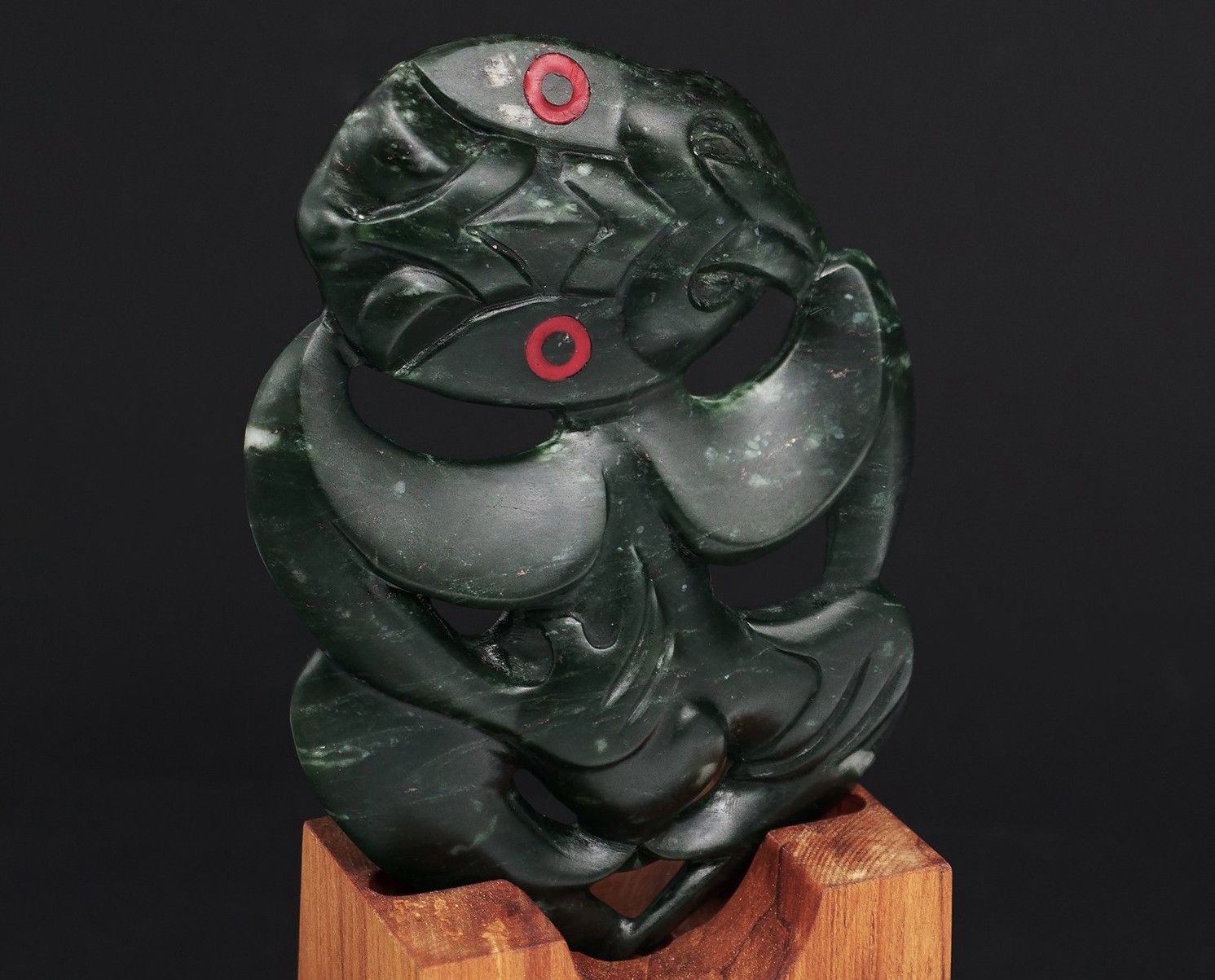
Pounamu has long been treasured in Aotearoa for its beauty, strength and spiritual significance. For Māori, it was far more than a material - it was a taonga, woven into whakapapa, trade, ceremony and daily life.
Long before European arrival, pounamu was carefully sourced, worked and traded throughout the country, with Ngāi Tahu hapū holding mana over much of the stone’s movement to the North Island.
Pounamu has always carried deep cultural meaning, shaped by whakapapa, place and careful stewardship - values that continue to guide how we work with the stone today. Learn more about the cultural significance of pounamu.
When European whalers, sealers and traders began arriving in the late 18th and early 19th centuries, their metal tools slowly reduced the practical need for pounamu as a tool or weapon. Yet rather than diminishing its value entirely, this period set the stage for one of the most ambitious — and ultimately ill-fated — chapters in the stone’s history.
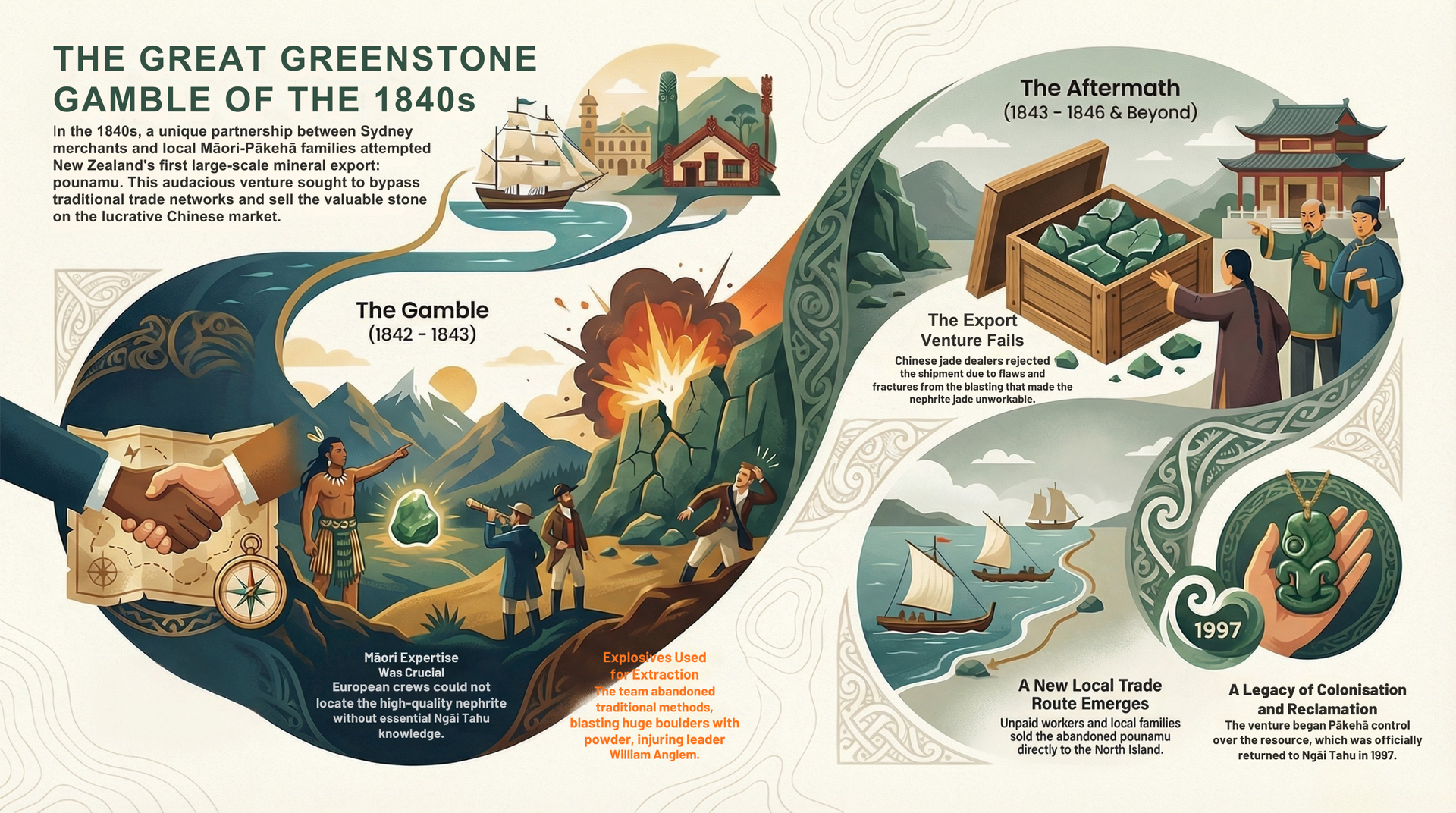
During the 1840s, a group of international speculators attempted to turn pounamu into a global export commodity, bypassing traditional Māori trade networks altogether. In doing so, they launched what is believed to be New Zealand’s first large-scale mineral export by Europeans.
A Partnership Born of Change
The venture unfolded between 1842 and 1846, at a time when the sealing and whaling industries that had sustained many southern communities were in decline. Māori–Pākehā families, already closely connected through marriage and shared work, began searching for new economic opportunities.
The pounamu speculation was a collaboration of necessity. Sydney-based merchants provided capital, European mariners brought ships and logistical know-how, and Māori supplied the most critical element of all: knowledge of the land and the stone itself.
At the centre of the operation was Captain William Anglem, an Irishman who spoke several languages and was married to Maria Te Anau, a woman of high rank within Ngāi Tahu and a close relative of the leader Topi Pātuki. Anglem’s relationship with his wife’s whānau was fundamental to gaining access to pounamu — access that could not be achieved without trust, whakapapa and permission.
Financial backing came primarily from Captain Ranulph Dacre, a prominent Sydney trader, and Henry Elgar, an English banker’s son then based in China. Their aim was bold: to source pounamu in volume and sell it into Asian markets where jade was already highly prized.
Searching for the Stone
The first export attempts began in South Westland. Early shipments collected in 1842 likely consisted of bowenite (tangiwai) from Anita Bay in Piopiotahi (Milford Sound). Bowenite was more accessible and easier to split than nephrite, but it was widely regarded by Māori as inferior to nephrite jade – it was valued for its colour, but was softer and less durable.
With the first shipment of Bowenite having proven reasonably successful, the suggestion from Anglem’s Māori whanau was that sourcing and sending the higher-quality nephrite might provide an even greater return in the Chinese market.
After consultation with his Māori relatives, Anglem redirected efforts north to Papaki (Barn Bay), where a significant nephrite source was eventually identified.
For the European crew, finding pounamu proved extraordinarily difficult. In its natural state, nephrite is almost indistinguishable from surrounding rock. Only a trained eye shaped by generations of experience could recognise it. Māori involvement was therefore essential. One account records that a kaumātua brought from Bluff located suitable stone after entering a deep sleep, before guiding the crew directly to the site.
Danger, Desperation and Disaster
Once large boulders of pounamu were found, including a massive stone estimated at around 50 tonnes, (which is still visible today) the work became increasingly dangerous. Traditional methods of breaking and shifting the stone were abandoned in favour of blasting it with gunpowder.
This decision had devastating consequences. In January 1843, a mistimed explosion seriously injured Anglem and several others. Anglem’s hands were shattered, he later lost the sight in one eye, and a finger had to be amputated and spent a month in Nelson trying to recover.
Despite the cost, risk and human toll, large quantities of nephrite were eventually shipped to Manila and then Macao onboard the Royal Mail, captained by Anglem. But the result was not what the speculators had hoped for.
Rejected by the Market
While nephrite was highly prized by Māori, Chinese jade dealers were unimpressed with the South Westland stone. The distinctive colour variations and black inclusions, typical of South Westland pounamu and features that many now consider part of the stone’s character, were reportedly viewed as flaws by the Chinese buyers. Dealers preferred the purer green jade they were accustomed to.
It is also likely that the use of explosives had fractured or weakened the stone internally, rendering it unsuitable for carving - something the prospectors would not have understood at the time. Some accounts even suggest that jade merchants in Canton deliberately declined the shipment to protect their existing market.
The financial fallout was severe. Henry Elgar was ruined. Dacre reportedly lost around £10,000. Captain Anglem returned to Rakiura (Stewart Island) in poor health and in dire financial straits and died shortly afterwards in 1846.
The final destination of the 50 boxes of unsold pounamu that had been exported to Macao is unknown. It was retrieved from storage in 1851 apparently by Dacre at the cost of £7,000 but no further information is available about what happened to it.
A Shift in Trade, and a Legacy That Remains
Although the international export venture failed, the pounamu itself did not disappear. After the syndicate withdrew, Māori workers in Te Wahi Pounamu who were left unpaid and short of supplies buried the remaining stone on the West Coast.
Soon after, Māori–Pākehā families recovered this pounamu and shipped several tonnes directly to the North Island between 1845 and 1846, particularly to Wellington and Whanganui.
This new trade route bypassed traditional Ngāi Tahu networks and is believed to have influenced the number of taonga produced during the contact period. Many of these pieces are now held in North Island museum collections.
Physical traces of the ill-fated 1840s operation remain today: pounamu boulders bearing drill holes from metal tools, and scars from blasting along the South Westland coast. This period also marks the beginning of Pākehā attempts to claim control over pounamu, based on the incorrect assumption that the Crown held mineral rights to the South Island thanks to the Treaty of Waitangi.
That assumption was finally corrected more than a century later with the Ngāi Tahu (Pounamu Vesting) Act 1997, which returned ownership and authority over pounamu to Ngāi Tahu.
This remarkable chapter in our history speaks to the resilience and ingenuity of Māori–Pākehā communities, the irreplaceable value of Ngāi Tahu knowledge, and the enduring power of pounamu itself. It is a reminder that while pounamu may travel across oceans, its origins - and its mana - are always rooted here.
Moko Pounamu Knowledge Library